
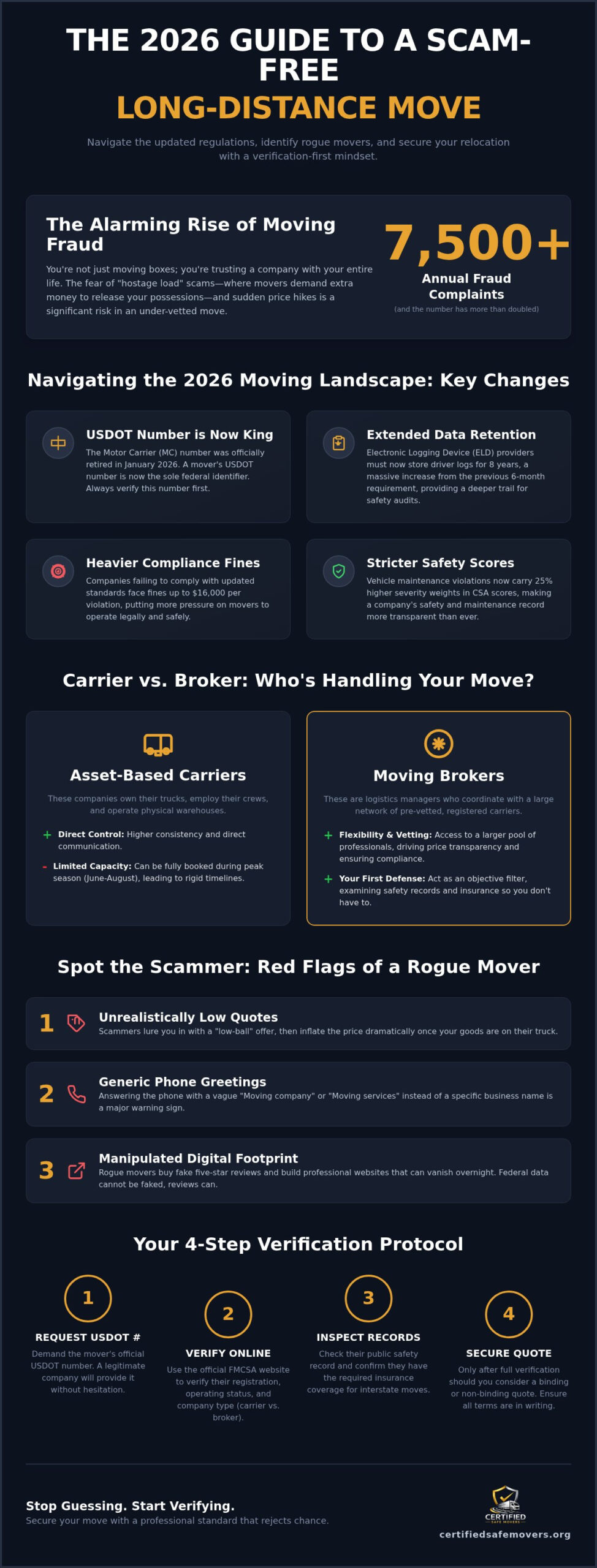
Did you know that moving fraud complaints have more than doubled in recent years, reaching over 7,500 annually? It’s a sobering reality for anyone researching long distance movers. You aren’t just moving boxes; you’re handing over your entire life to a stranger. The fear of a “hostage load” scam or a sudden price hike after the truck is packed is enough to keep anyone awake at night. You deserve a relocation process that’s defined by safety, not luck.
We understand the anxiety that comes with cross-country relocation. It’s confusing to navigate binding versus non-binding quotes while worrying about high-value items. Our expert-vetted guide promises to replace that doubt with controlled safety. You’ll master the complexities of the 2026 moving landscape, from verifying USDOT credentials to securing price transparency. We’ve done the hard work of vetting the industry so you can move with absolute confidence. Check the credentials. Confirm the insurance. Secure your peace of mind. This guide provides the gold standard for a scam-free relocation.
Key Takeaways
- Navigate the updated 2026 federal regulations for interstate moves to ensure your chosen provider meets the latest compliance and safety benchmarks.
- Learn the critical differences between asset-based carriers and moving brokers to choose the logistics model that best fits your security needs.
- Identify the top five red flags of rogue long distance movers, such as low-ball quotes and generic phone greetings, to shield yourself from “hostage load” scams.
- Master a step-by-step verification protocol to cross-reference business histories and confirm that your mover is legally registered and insured.
- Leverage the Mover Certification Program to filter out high-risk options and secure a verified, professional relocation experience.
Navigating the Long-Distance Moving Landscape in 2026
Long-distance moving is defined by more than just a long drive. It refers specifically to interstate moves or relocations exceeding 100 miles that require federal oversight. When you cross state lines, you enter a regulated environment governed by the Department of Transportation (DOT) and the Federal Motor Carrier Safety Administration (FMCSA). In 2026, the landscape has shifted significantly. The Motor Carrier (MC) number was officially retired in January 2026. Now, every legitimate operation must be identified solely by its USDOT number. This change was designed to reduce fraud, but it requires a “Verification-First” mindset from consumers. You can’t rely on old credentials. You must check the current status of your long distance movers before making a commitment.
The Stakes of Interstate Relocation
Moving across town is a simple task. Moving across the country is a high-stakes logistics operation. It involves a complex supply chain of drivers, dispatchers, and equipment. A foundational overview of the moving industry reveals how these national networks operate. The emotional and financial risks are immense. You’re handing over your most valuable possessions to a system that must function perfectly over thousands of miles. New 2026 regulations now require Electronic Logging Device (ELD) providers to store driver logs for eight years. This increase from the previous six-month requirement provides a deeper trail for safety audits. If a company fails to comply with these updated standards, they face fines of up to $16,000 per violation. These are the details that separate professional relocators from risky gambles.
Why Traditional Vetting Fails
Five-star reviews are no longer a sufficient trust signal. Rogue movers have become experts at manipulating digital footprints. They buy fake testimonials and launch professional-looking websites that vanish when trouble starts. They often use generic phone greetings like “moving services” to hide their true identity. With moving fraud complaints exceeding 7,500 annually, the stakes have never been higher. Digital reviews can be faked; federal data cannot. You need a standard that goes beyond surface-level aesthetics. In 2026, vehicle maintenance violations carry 25% higher severity weights in CSA scores. This means a company’s safety record is more transparent than ever if you know where to look. Identifying reliable long distance movers requires a certified approach that prioritizes hard data over marketing promises. Stop guessing. Start verifying. Secure your move with a professional standard that rejects chance.
Understanding Moving Logistics: Carriers, Brokers, and Networks
Choosing between different types of long distance movers requires an understanding of how the industry is structured. You’ll encounter two primary models: asset-based carriers and moving brokers. Asset-based carriers own their trucks, employ their own crews, and maintain physical warehouses. This model offers direct control over the relocation process, which can lead to higher consistency. However, these companies often face capacity limits during the peak season from June through August. If their fleet is full, they simply can’t help you. This lack of flexibility often forces consumers into rigid timelines that don’t fit their needs.
Moving brokers operate differently. They don’t own trucks or provide physical labor. Instead, they act as logistics managers who coordinate with a network of carriers. Legally, brokers must identify themselves as such and are required to only book moves with FMCSA-registered carriers. This model expands your options by creating a competitive environment where multiple carriers vie for your business. It drives price transparency and ensures you aren’t tied to the availability of a single company’s fleet. By leveraging a broader network, you gain access to a larger pool of vetted professionals.
The Role of the Modern Brokerage
A professional brokerage serves as your first line of defense against industry risks. Their primary value lies in the vetting process. They act as an objective filter, examining safety records and insurance credentials before any contract is signed. This management layer removes the burden of verification from your shoulders. It transforms a chaotic search into a streamlined selection process. You can access a verified directory to see how this protective expertise simplifies your search. By handling logistics management without the labor, a brokerage ensures every participant in your move meets a specific quality standard.
Asset-Based Movers vs. Logistics Platforms
Deciding which model fits your move depends on your timeline and risk tolerance. Single-company fleets offer a “one-stop-shop” feel, but they lack the scalability of a logistics platform. Platforms and directories provide higher capacity, making them ideal for last-minute or complex relocations. Standards for these operations are often discussed at the Moving & Storage Conference, where industry leaders set benchmarks for safety and reliability. While a single company depends on its own internal staff, a logistics network relies on a gold standard of verification to maintain quality across thousands of independent long distance movers. This creates a safety net that protects you from the limitations of any single provider.
Identifying the ‘Rogue Mover’: Red Flags and Safety Standards
Rogue movers operate by exploiting your desire for a low price. With over 7,500 fraud complaints reported to the FMCSA in recent years, the risk to your belongings is significant. These operators often hide behind generic phone greetings like “moving services” or lack a verifiable physical business address. A legitimate provider of long distance movers will always insist on a physical or virtual survey of your home. Any estimate provided without a visual inspection of your inventory is a major warning sign that the company is cutting corners or preparing a scam.
The “Hostage Load” scam remains the most devastating tactic used by fraudulent operators in the interstate market. These companies lure you with an attractive price, load your life’s possessions onto a truck, and then demand thousands of dollars in additional fees before they will deliver your items. To shield yourself from these predatory practices, consult the FMCSA’s Protect Your Move guidance. Real safety is built on rigorous verification, not on the hope of a good deal.
The Anatomy of a Low-Ball Quote
Low-ball quotes are a psychological trap designed to bypass your intuition. They target your budget to distract you from missing credentials. You must understand the difference between estimate types to maintain control over your costs. A binding estimate guarantees the total price based on the current inventory. A non-binding estimate is merely a projection that can fluctuate wildly after the truck is weighed. The gold standard for consumer protection is the “binding-not-to-exceed” quote. This document ensures you never pay more than the original estimate even if the weight is higher than expected. Use a checklist when reading the fine print. Look for hidden accessorial charges, fuel surcharges, and specific delivery windows. If these details are absent or vague, the contract is a risk. Familiarize yourself with the warning signs common to fraudulent long distance moving services so you can recognize these tactics before signing anything.
Federal Compliance and DOT Standards
Every legal interstate move must follow strict federal protocols that prioritize consumer safety. Legitimate long distance movers are legally required to provide you with the “Your Rights and Responsibilities When You Move” booklet during the planning phase. This document outlines your legal protections and the mover’s obligations. You should also check the FMCSA safety profile using the company’s USDOT number to verify their Compliance, Safety, Accountability (CSA) scores. In 2026, vehicle maintenance violations carry 25% higher severity weights, making it easier to spot companies that neglect their equipment. The Bill of Lading is the most critical legal document in your relocation, serving as your formal contract and your receipt for goods. Never sign a blank or incomplete Bill of Lading. Professionalism is defined by transparency and adherence to these federal benchmarks.
The 2026 Verification Protocol: How to Vet Your Mover
Securing a safe relocation requires a systematic approach to due diligence. You can’t rely on gut feelings or polished websites. Instead, implement a rigorous verification protocol to identify legitimate long distance movers. This five-step process moves you from uncertainty to informed confidence by using data-driven tools and federal standards. It eliminates the guesswork that often leads to moving fraud. Follow these steps to protect your belongings and your budget.
- Step 1: Use the Mover Verification Tool to confirm federal registration and USDOT authority.
- Step 2: Cross-reference physical addresses with business records to ensure the company exists beyond a digital storefront.
- Step 3: Check for the Mover Certification Program status to validate higher safety and quality benchmarks.
- Step 4: Utilize a Moving Cost Calculator to establish a realistic price baseline before accepting quotes.
- Step 5: Verify liability options, choosing between basic Released Value and comprehensive Full Value Protection.
Using the Mover Verification Tool
The first line of defense is the Mover Verification Tool. Input the company’s USDOT number to access real-time safety data. In 2026, checking for “authorized” status is critical for any interstate move. If a company is only registered for intrastate commerce, they cannot legally cross state lines with your goods. The Certified Safe Movers database provides an additional layer of security by filtering these records for you. It ensures the carrier has a clean history of compliance with the latest FMCSA regulations, including the new eight-year ELD data retention rules. Use this tool before you request a single quote to ensure you only deal with legal operators.
The Science of the Moving Cost Calculator
Phone estimates are often inaccurate because they rely on verbal descriptions rather than hard data. A Moving Cost Calculator uses specific variables like inventory weight, travel distance, and current fuel surcharges to build a baseline. In 2026, fuel surcharges typically add 10% to 20% to the total cost. By entering these details yourself, you create a benchmark to measure against carrier quotes. If a quote is significantly lower than your calculated baseline, it’s a red flag for a potential scam. You can use our verification tool and calculator to take control of your relocation budget today. This data-driven approach prevents the “low-ball” trap and ensures price transparency from the start.
Finally, confirm your insurance coverage. Federal law requires long distance movers to offer Released Value Protection at no extra cost, but this only covers 60 cents per pound. For high-value items, Full Value Protection is the gold standard. It requires the mover to replace the item or pay for its current market value if it’s lost or damaged. Verify these options in writing before signing the Bill of Lading to ensure your assets are fully protected.
Secure Your Relocation with Certified Safe Movers
A cross-country move shouldn’t be a gamble. In a marketplace crowded with over 17,000 active moving companies, finding the right partner requires more than a simple search. It requires a filter. Certified Safe Movers serves as that objective shield, separating professional operators from high-risk entities. We operate from a position of protective expertise. We ensure that every company you consider has already passed our rigorous vetting process. Your relocation journey becomes streamlined, logical, and secure when guided by a professional standard. We aren’t a passive directory. We’re active participants in your safety.
The emotional weight of relocation is often heavy. You’re handing over your life’s possessions to a system that spans thousands of miles. Our role is to mitigate that anxiety. We replace doubt with a feeling of controlled safety. By acting as a consumer advocate, we provide the scrutiny that individual movers often avoid. We reject luck. We embrace verification. This commitment to transparency ensures that your long distance movers are legally compliant, properly insured, and held to the highest possible standards of reliability. We’ve done the hard work of vetting so you don’t have to.
Why Certification Matters
The Mover Certification Program is the ultimate mark of merit in the relocation industry. It goes beyond basic federal registration. It includes an ongoing monitoring process that tracks safety scores, insurance validity, and consumer complaint history. We reject chance. We prioritize validation. A certified provider must maintain high-register quality control standards to remain in our network. This continuous scrutiny means you don’t have to spend hours researching safety profiles yourself. We’ve already done the hard work of vetting. This allows you to move from indecision to informed confidence.
Your Next Steps to a Secure Move
Taking control of your relocation starts with the right tools. Use our resources to eliminate uncertainty and build a foundation of safety for your household goods. Follow this streamlined path to a secure move:
- Analyze your budget: Start with the Moving Cost Calculator to establish a realistic baseline for your 2026 relocation.
- Identify vetted pros: Browse the Moving Company Directory to find long distance movers who meet the gold standard of safety.
- Verify credentials: Use our integrated tools to confirm USDOT status and certification levels in real-time.
Confidence is the ultimate product we deliver. It’s the feeling of knowing your high-value items are in the hands of a verified professional. It’s the relief of price transparency. It’s the security of legal compliance. Replace doubt with controlled safety today. Secure your relocation. Protect your assets. Move with the peace of mind that only a certified standard can provide. Your journey to a new home deserves absolute certainty.
Take Control of Your Move Today
Relocation in 2026 is no longer a matter of finding a truck; it’s a matter of verifying authority. You’ve learned how to spot the red flags of rogue operations and how to understand the logistics of carriers and brokers. By following a strict verification protocol, you eliminate the gamble of price hikes and scams. You deserve a move that’s defined by safety and transparency. Don’t leave your life’s possessions to chance. Rely on a system built for protection.
We’ve already done the hard work of vetting the industry. Our proprietary Mover Certification Program and Instant Mover Verification Tool provide the gold standard of security for your journey. Access our National Directory of Vetted Relocation Professionals to find trusted long distance movers who meet our rigorous standards. Secure your move with a certified professional today. Replace uncertainty with a verified outcome. Your new beginning starts with a safe transition.
Frequently Asked Questions
What is considered a long-distance move in the United States?
A long-distance move is typically defined as any relocation that crosses state lines or exceeds 100 miles within a single state. These moves fall under federal jurisdiction and require specific oversight from the Department of Transportation. Unlike local moves that are governed by state-level rules, these operations must adhere to strict FMCSA safety standards. Understanding this distinction is the first step in identifying the right long distance movers for your relocation.
How do I verify if a moving company is legally registered for interstate moves?
You can verify a company’s legal status by checking their USDOT number through the FMCSA’s SAFER database. As of 2026, the MC number has been retired, so the USDOT number is the sole identifier for legal operations. Look for an “Authorized” status for property transport. Our Mover Verification Tool simplifies this by providing real-time safety data and registration status, ensuring you only engage with compliant and verified providers.
What is the difference between a moving broker and a moving carrier?
A moving carrier is a company that owns physical trucks and employs the labor to move your goods. A moving broker, like Certified Safe Movers, acts as a professional logistics manager. Brokers don’t own trucks; instead, they vet multiple carriers to find the best fit for your timeline and budget. This model increases competition and choice while ensuring that a third party is objectively verifying the carrier’s safety records and insurance credentials.
Can a moving company change the price after my belongings are loaded?
Legitimate companies cannot change a binding estimate once the contract is signed and the inventory is confirmed. However, rogue operators often use “hostage load” scams to demand extra fees after loading. To prevent this, always secure a binding-not-to-exceed estimate and ensure a physical or virtual survey was conducted. Price transparency is a core pillar of our Mover Certification Program, which filters out companies with a history of predatory pricing.
What are the most common red flags of a moving scam in 2026?
Top red flags include low-ball quotes that seem too good to be true, generic “moving company” phone greetings, and the lack of a physical business address. Be wary of companies that demand large upfront cash deposits or refuse to provide a written estimate after a visual survey. In 2026, the absence of a valid USDOT number on the company’s website is a definitive sign of a high-risk and potentially fraudulent operation.
How does the Mover Certification Program protect consumers?
The Mover Certification Program acts as a gold standard for quality assurance by rigorously vetting providers before they enter our network. We monitor safety records, insurance validity, and consumer complaint history in real-time. This ongoing scrutiny removes the burden of verification from your shoulders. By choosing a certified provider, you replace the gamble of a random search with the confidence of a verified and monitored professional standard that rejects chance.
Do I need separate moving insurance for a long-distance relocation?
While we don’t sell insurance policies, federal law requires long distance movers to provide Released Value Protection at no extra cost. This covers only 60 cents per pound of your belongings. For comprehensive protection, you should opt for Full Value Protection directly through your mover. This ensures the company is liable for the replacement value of lost or damaged items. Always verify these liability options in writing before signing your final contract.
How far in advance should I book a long-distance mover?
You should aim to book your relocation at least eight to twelve weeks in advance, especially if you are moving during the peak season from June through August. High demand during these months can reduce availability and increase rates by 20% to 30%. Early booking allows you to utilize our Moving Cost Calculator to establish a budget baseline and gives you ample time to vet multiple certified professionals for your move.