

If a moving estimate feels like a lucky guess, you’ve already lost control of your relocation. Entrusting your entire life to moving services should never be a gamble. It’s a high-stakes security transaction that requires rigorous validation. You’re right to worry about belongings being held hostage or price estimates that seem too good to be true. The industry can be opaque. The regulations are complex. The stakes are incredibly high.
You deserve a move defined by certainty, not chance. We’ve developed a professional vetting protocol to help you identify bad actors before they ever reach your driveway. It’s about protection. It’s about precision. It’s about peace of mind. This article provides a clear checklist of warning signs to watch for during your search. You’ll learn how to verify federal credentials, spot low-ball estimates, and confirm regulatory compliance. Use these standards to eliminate the guesswork and build a predictable moving budget. Let’s secure your journey.
Key Takeaways
- Learn why a security-first mindset is the only way to safeguard your belongings against industry “hostage” tactics.
- Discover the five critical warning signs that signal a provider of moving services may be a rogue operator in disguise.
- Understand the operational gap between brokers and carriers to ensure your contract offers the protection you expect.
- Master a professional four-step protocol for verifying mover credentials through federal databases and physical site checks.
- Access specialized certification tools designed to eliminate budget uncertainty and validate the legitimacy of your chosen provider.
Why Moving Services Require a Security-First Mindset
Relocating across state lines isn’t just a logistical challenge; it’s a massive transfer of assets. You’re effectively handing over every piece of furniture, family heirloom, and personal document to a third party. In a standard moving industry overview, you’ll see that this sector is built on trust, but trust without verification is a liability. The industry is a frequent target for rogue operators who exploit the vulnerability of families in transition. Adopting a security-first mindset means you stop viewing relocation as a service to be bought and start viewing it as a transaction to be secured.
Professional standards transform a risky gamble into a verified process. By using tools like our Mover Verification Tool, you can filter out entities that lack the necessary federal authority. This isn’t about being cynical. It’s about being prepared. High-quality moving services are built on a foundation of transparency and regulatory compliance. We focus on validation. We focus on risk mitigation. We focus on reliability.
The True Cost of a Failed Relocation
A failed move costs more than the digits on a quote. When a company holds your goods hostage for thousands in extra fees, the financial impact is immediate and devastating. Beyond the money, there’s the crushing emotional stress of missing items or delayed deliveries that stretch into weeks. Interstate moving disputes often lead to complex legal battles where federal regulations can be difficult to enforce without prior documentation. A secure vetting process prevents these outcomes. It protects your budget. It protects your sanity. It protects your future.
Defining the ‘Rogue Mover’ in 2026
The rogue mover of 2026 is a digital chameleon. These unlicensed entities often operate under multiple names, switching identities the moment negative reviews catch up to them. They rarely own physical assets like a fleet of trucks or a permanent warehouse. Instead, they act as phantom providers of moving services, renting equipment only after they’ve secured your deposit. Their primary strategy is the low-ball estimate, a price point so far below the market average that it should immediately trigger your internal alarm. If a company can’t prove it has a physical office or a history of transparent operation, it isn’t a service provider; it’s a risk.
5 Critical Red Flags in Professional Moving Services
Identifying a legitimate provider of moving services requires a critical eye for detail. While marketing materials promise a seamless experience, the reality of the industry involves specific operational markers that distinguish professionals from rogue operators. The Federal Motor Carrier Safety Administration (FMCSA) maintains a comprehensive list of moving company red flags that every consumer should memorize. These signs aren’t just inconveniences. They are indicators of systemic risk. Professionalism is not a suggestion; it is a requirement.
Watch for these immediate warning signs during your initial contact:
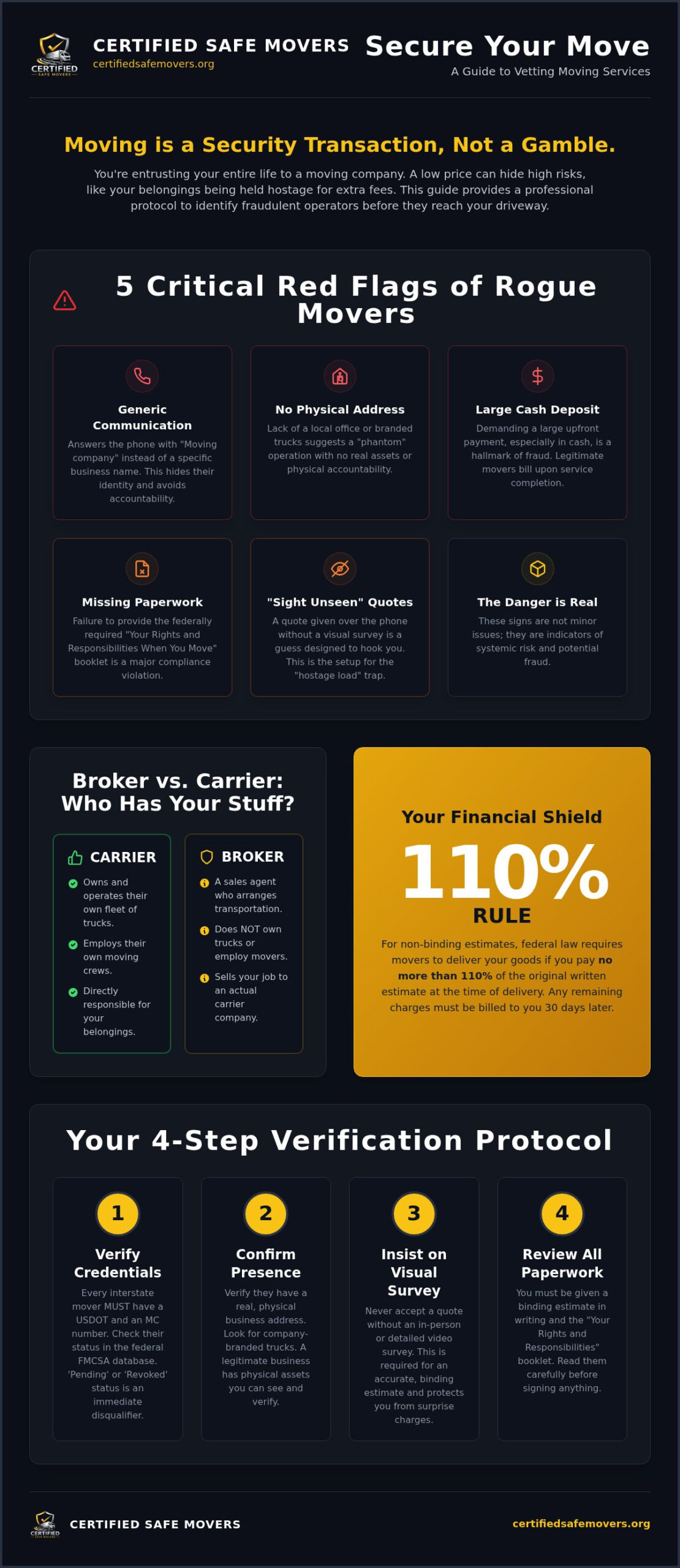
- Generic Communication: If a representative answers the phone as “Moving Company” rather than using a specific brand name, they are likely hiding their identity.
- Physical Absence: A lack of a local business address or a fleet of branded trucks suggests a “phantom” operation with no accountability.
- Financial Pressure: Demanding a large cash deposit before any work begins is a hallmark of fraud. Legitimate firms operate on verified contracts.
- Missing Paperwork: Failing to provide the federally mandated “Your Rights and Responsibilities When You Move” booklet is a major compliance failure.
The Danger of the Over-the-Phone Estimate
A binding estimate is your primary financial shield, but it’s worthless if it’s based on a guess. Legitimate movers require a visual survey, either in-person or via a detailed video walkthrough, to calculate weight and volume accurately. Rogue movers use “sight unseen” quotes to hook you with a low price. Once your belongings are loaded, they “re-calculate” the cost, often doubling the price on delivery day. This is the hostage load trap. To avoid these low-ball tactics, you can use our Moving Cost Calculator to establish a realistic baseline for your relocation budget. Verify the data. Trust the numbers. Avoid the trap.
Analyzing Commercial Credentials
Credentials are the gold standard of validation. Every interstate mover must have a USDOT number to track safety records and an MC number to grant operating authority. A missing number is an immediate disqualifier. However, presence isn’t enough. You must verify the status. Check for “pending” or “revoked” authority in the FMCSA database. In 2026, the 110% rule remains a critical protection; movers are required to deliver goods for no more than 110% of a non-binding estimate. If a provider ignores this federal standard, walk away early. A company with a history of changing its name or USDOT number every two years is likely trying to outrun a trail of complaints. Check the record. Secure the move.
Evaluating Service Providers: Brokers vs. Carriers
Understanding the architecture of the moving industry is a prerequisite for a secure relocation. The marketplace for moving services is divided into two distinct categories: brokers and carriers. This distinction is not just industry jargon; it defines who is legally responsible for your belongings. Carriers are the entities that own the trucks, employ the drivers, and maintain the physical equipment. They are the ones who perform the actual haul. Brokers are professional intermediaries. They arrange the logistics and sell the job but do not provide the physical transportation themselves.
Federal law requires brokers to disclose their status in all marketing materials and contracts. If a company is vague about whether they own their fleet, you should consider it a major warning sign. Knowing who owns the truck is vital for your security. If your inventory is delayed or a dispute arises, you need to know exactly whose insurance and USDOT authority is on the line. A carrier’s safety record and registration history are tied to their specific MC number. When you hire a broker, you must ensure they only assign your move to a carrier with an active, verified status. Verification is the only path to certainty.
When to Use a Certified Brokerage
A certified brokerage acts as a professional filter between you and a crowded marketplace. They provide access to a vetted network of professional carriers that have already passed rigorous quality checks. This model offers centralized accountability. If a dispute occurs, you have a consumer advocate who can facilitate a resolution and hold the carrier to a specific standard. Utilizing a brokerage with a high-register vetting process streamlines your search. It replaces the exhausting task of checking individual companies with a single, reliable point of entry. It’s about efficiency. It’s about standards. It’s about control.
Risks of Unmanaged Carrier Selection
Hiring a carrier directly without an objective vetting protocol is a high-stakes gamble. Many individual small fleets lack the administrative infrastructure to handle interstate disputes or complex damage claims. You become the investigator. You are responsible for verifying every DOT filing, safety rating, and insurance policy. Without the oversight provided by a Mover Certification Program, your recourse in the event of loss is often limited to the carrier’s internal policies. Professional certification removes this burden. It ensures that any provider of moving services has been scrutinized by an objective third party, rejecting chance in favor of proven reliability.
The 4-Step Verification Protocol for Secure Selection
Selection is not a matter of convenience. It is a matter of compliance. Most platforms prioritize booking speed, but a secure relocation requires a methodical vetting process. Follow this 4-step protocol to isolate legitimate moving services from high-risk entities.
- FMCSA Database Check: Visit the Federal Motor Carrier Safety Administration ‘Protect Your Move’ portal to verify the company’s registration status.
- Address Mapping: Verify the physical office through independent mapping software to ensure the business operates from a legitimate commercial facility.
- Proprietary Tool Cross-Reference: Use specialized verification tools to check for internal safety certifications and historical performance data.
- Mandatory Booklet Request: Demand the federally required ‘Your Rights and Responsibilities When You Move’ document as a test of operational transparency.
Verifying Federal Registration
Use the SAFER system to perform a deep dive into the company’s USDOT and MC numbers. Confirm that their status is ‘Active’ and that every provider of moving services you consider is ‘Authorized for Hire’ for household goods. Check the ‘Insurance on File’ section to ensure they carry the mandatory public liability coverage. In 2026, the FMCSA requires a minimum of $750,000 in liability insurance. Examine the history log for frequent name changes. A company that rebrands every 18 months is often trying to bury a record of safety violations or consumer complaints. Check the status. Verify the address. Secure the contract.
Interpreting Consumer Protection Data
Raw complaint numbers can be misleading. You must analyze the complaint-to-move ratio. A large carrier will naturally have more complaints than a small one. Distinguish between service-related issues, such as a late arrival, and critical safety violations. In 2026, roadside inspection failures regarding Electronic Logging Devices (ELDs), medical certifications, or falsified Driver Vehicle Inspection Reports (DVIRs) are severe indicators of operational neglect. A willfully falsified DVIR can carry penalties up to $19,000 per violation. These regulatory red flags are far more significant than a one-star review about a scratched table. Prioritize safety data over subjective feedback.
To ensure your provider meets the gold standard of safety, access our Mover Verification Tool before signing any agreement.
Moving with Confidence: Utilizing Certification Tools
Confidence isn’t a feeling. It’s a verified state. Once you’ve identified the red flags, you need a proactive system to confirm quality. Selecting moving services should be a methodical process of elimination. The Mover Certification Program serves as this final filter. It bridges the gap between federal minimums and professional excellence. By accessing a directory of vetted relocation professionals, you replace the anxiety of a blind search with the precision of a curated selection. This is how you secure your household goods. This is how you protect your transition. Professionalism is the goal. Validation is the method.
Establishing a Realistic Budget
Rogue estimates thrive in price vacuums. If you don’t know the market rate, a low-ball quote looks like a deal instead of a trap. Use the Moving Cost Calculator to establish a baseline before you speak to sales representatives. In 2026, the average cost of a long-distance move ranges between $2,197 and $16,897. A typical 1,000-mile move for a 2-3 bedroom home costs approximately $5,451. These figures are influenced by fuel charges, weight, and distance. Compare every quote against these industry averages. If a provider of moving services offers a price significantly below these markers, they are likely cutting corners on compliance or planning a “hostage” fee on delivery day. For a comprehensive breakdown of what to expect when hiring long distance movers in 2026, including how to verify USDOT credentials and secure price transparency, review our definitive industry guide. Remember the 110% rule: interstate movers must deliver goods for no more than 110% of a non-binding estimate. Validate the math. Secure the budget. Protect the move.
The Security Advantage of Certified Safe Movers
Our vetting process goes beyond checking a USDOT number. We analyze historical performance, insurance consistency, and regulatory adherence to ensure every provider meets a gold standard. While generic directories focus on speed, we focus on risk mitigation. You aren’t just hiring a company; you’re entering a high-register security agreement. A verified directory removes the need for further guesswork. It allows you to finalize your contract with the knowledge that your provider has been scrutinized by experts who are on your side. We act as an objective filter between you and a crowded marketplace. Don’t leave your belongings to chance. Your next steps are clear: Secure your move today by utilizing our professional vetting tools. Check the record. Secure the move. Relocate with confidence.
Secure Your Relocation with Professional Standards
Vetting isn’t just a precaution; it’s the foundation of a successful move. You now have the functional tools to distinguish between legitimate moving services and rogue operators. By identifying red flags like sight-unseen estimates and verifying federal MC numbers, you’ve moved from a state of uncertainty to one of controlled safety. You’ve replaced chance with a professional security-first protocol. This shift in perspective is what prevents hostage loads and budget surprises. It ensures your belongings are handled by authorized professionals.
Our platform acts as a vigilant guardian between you and the marketplace. We provide access to our Mover Verification Tool and a national network of vetted relocation pros. We apply proprietary Mover Certification standards to ensure every provider meets a gold standard of safety. You don’t have to navigate complex federal regulations alone. Use our specialized resources to eliminate risk and secure your household goods. Take the final step toward a predictable, stress-free relocation. Verify your mover and get a secure quote today. Your journey deserves the gold standard of protection. Move with confidence.
Frequently Asked Questions
What is the most common moving service scam?
The “hostage load” scam is the most frequent industry fraud. This occurs when a company provides a low-ball estimate to secure the contract and then increases the price significantly after your goods are on the truck. They refuse to deliver the items until you pay the additional fees in cash. To prevent this, always cross-reference companies through a professional verification system before signing any agreement.
How do I check if a moving company is legally registered?
You must verify their credentials through the FMCSA SAFER database using their USDOT or MC number. A legitimate provider of moving services should have an “Active” status for interstate household goods authority. You should also check for a physical commercial address and current insurance filings. Our Mover Verification Tool simplifies this process by aggregating these regulatory data points into a single, easy-to-read report for your security.
Can a moving company change the price after loading the truck?
Legally, interstate movers cannot exceed 110% of a non-binding estimate at the time of delivery. If you have a binding estimate, the price is fixed based on the inventory list provided. However, rogue movers often ignore these federal regulations to extort extra fees. If a company attempts to change the price significantly after loading, it is a major red flag. Documentation and a visual survey are your best defenses against price spikes.
What is the difference between a binding and non-binding estimate?
A binding estimate guarantees the total cost of the move based on the items and services listed in the contract. A non-binding estimate is a projection of the final cost based on the weight of your goods and actual services performed. While non-binding quotes can fluctuate, federal law protects you from paying more than 110% of the initial estimate upon delivery. Always request a written inventory to ensure your quote remains accurate.
Should I ever pay a large deposit for moving services?
No, you should never pay a significant cash deposit before your items are loaded. Most reputable moving services require payment upon delivery or through a verified credit card transaction. Rogue operators often demand large upfront payments to secure their profit before disappearing or providing substandard service. If a company pressures you for a deposit exceeding a small administrative fee, it is a sign to look for a certified alternative.
What documents should I receive before the move begins?
You are legally entitled to receive several specific documents before your relocation starts. These include the “Your Rights and Responsibilities When You Move” booklet, a written estimate, and an Order for Service. You should also receive a Bill of Lading, which serves as your contract and receipt for your goods. Review these documents carefully to ensure they match the verbal promises made by the company representative. Verification is your primary shield.
How do I report a rogue mover to federal authorities?
You can file a formal complaint through the FMCSA National Consumer Complaint Database. This system tracks violations related to hostage loads, unauthorized operations, and insurance failures. You should also contact your state’s Attorney General and the Better Business Bureau. Providing specific details, such as the company’s USDOT number and copies of your signed contract, helps authorities build a case against fraudulent entities and protects future consumers from similar risks.
Is a moving broker better than a direct carrier?
The choice depends on your vetting process. A certified broker provides access to a pre-vetted network of carriers, which can save time and offer centralized accountability. A direct carrier owns the equipment and performs the physical labor. Both models are legitimate if they are transparent about their status. The key is to use a Mover Certification Program to ensure that whichever entity you choose meets rigorous safety and reliability standards. Don’t leave it to chance.