In 2026, a handshake and a “good feeling” are no longer enough to protect your life’s belongings. Trust is no longer a sentiment; it’s a verified data point derived from rigorous certification standards. Finding reliable cross country moving services shouldn’t feel like a high-stakes gamble with your home. You’ve likely heard the horror stories of “hostage load” scams where prices double mid-transit or high-value heirlooms simply vanish into a logistical black hole. It’s exhausting to untangle the confusing overlap between brokers and carriers while trying to manage the stress of a relocation. We understand that anxiety. You deserve a move defined by transparency, not hidden fees and uncertainty.
This guide empowers you to master the latest security protocols, from the new Broker Financial Responsibility Rule to mandatory digital inspection trails. You’ll learn exactly how to verify a mover’s legitimacy using the gold standard of industry vetting. We’ll provide a clear checklist of security standards, show you how to ensure your quote is binding, and grant you access to a directory of movers who have already passed the most stringent assessments. It’s time to replace doubt with controlled safety. Check. Confirm. Secure.
Key Takeaways
- Identify the 2026 gold standard for relocation security, including the latest federal mandates on broker financial responsibility and digital inspection trails.
- Master the process of vetting cross country moving services by verifying active USDOT licensing to ensure legal and safe operations.
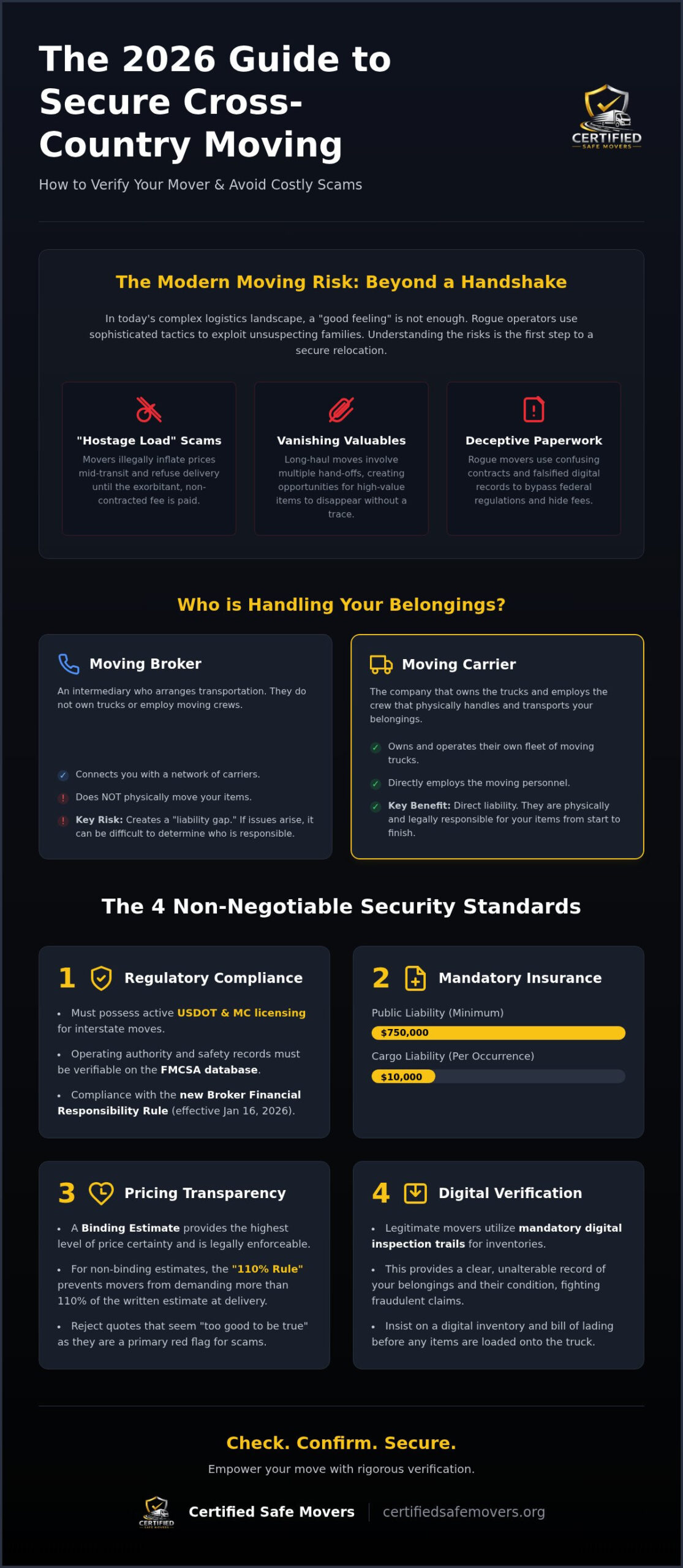
- Distinguish between moving brokers and carriers to bridge the liability gap and understand exactly who is physically responsible for your items.
- Utilize independent verification tools and cost calculators to identify unrealistic quotes and eliminate the risk of “hostage load” scams.
Why Cross Country Moving Services Require a Security-First Mindset
Relocating across state lines is one of the most significant financial and personal transactions a household will ever undertake. It is not merely a logistics problem. It is a security risk. When you hire cross country moving services, you are handing over the keys to your entire life: your furniture, your heirlooms, and your sensitive documents. In 2026, the complexity of long-haul logistics has increased, making a proactive verification strategy the only way to ensure a safe arrival. Relying on luck is a gamble you cannot afford to take.
The Vulnerability of Long-Distance Relocation
Distance creates a natural barrier to oversight. Once the truck leaves your driveway, your belongings enter a phase of transit where you have zero physical control. Long-haul moves often involve multiple hand-offs between different crews or storage intervals in various states. Each touchpoint is a potential point of failure for your security. Navigating the regulatory landscape is equally complex, as trucks must comply with shifting multi-state safety mandates and FMCSA standards. In 2026, a “hostage load” occurs when a mover takes possession of a client’s goods and refuses delivery until an illegally inflated, non-contracted fee is paid, often bypassing the new federal financial responsibility rules through deceptive paperwork.
Moving Scams vs. Professional Standards
Rogue movers have evolved in the digital age. They use sophisticated websites and fake review profiles to bypass traditional consumer checks. To understand the baseline of the industry, one must look at what is a moving company and the federal regulations that govern them. In 2026, the FMCSA has implemented stricter digital trails for inspections, yet rogue operators still find ways to falsify records if they aren’t subjected to independent vetting. Standard review sites are no longer sufficient. They are easily manipulated. They lack technical verification. They offer a false sense of security.
These rogue operators typically use the low-ball quote tactic, offering a price that seems too good to pass up. Once they have your items, the price skyrockets. The psychological cost of this uncertainty is devastating for families. Shifting to a security-first mindset means rejecting the gamble of unverified reviews. It requires rigorous certification. It demands transparency. It ensures peace of mind. By moving from “hoping for the best” to a strategy of active validation, you reclaim control over your relocation journey. Check the credentials. Confirm the identity. Secure the outcome.
The 4 Non-Negotiable Security Standards for National Relocation
In 2026, trust is not a sentiment. It is a verified data point. When you evaluate cross country moving services, you must look past polished websites and focus on technical benchmarks that prove operational integrity. These four standards form the defensive line between a successful move and a logistical disaster. Relying on a “good feeling” is a risk you don’t need to take. Instead, rely on rigorous validation.
Regulatory Compliance and Licensing
A legitimate mover must possess active USDOT and MC licensing for interstate commerce. This is the baseline for legal operation. You can verify a company’s safety record and operating authority through the Federal Motor Carrier Safety Administration database. For a comprehensive guide on what to look for, consult the FMCSA’s Protect Your Move checklist. In 2026, interstate movers are required to maintain a minimum of $750,000 in public liability insurance. They must also hold cargo liability coverage with minimums of $5,000 per vehicle and $10,000 per occurrence. Basic “60 cents per pound” coverage is rarely enough for high-value items; always confirm the carrier’s full valuation options before signing.
Pricing transparency is the second pillar of security. Federal regulations protect you here. For non-binding estimates, the “110% Rule” stipulates that a mover cannot demand more than 110% of the written estimate at the time of delivery. However, a binding estimate provides the highest level of price certainty. It ensures your quote is fixed regardless of final weight fluctuations. The new Broker Financial Responsibility Rule, which took full effect on January 16, 2026, adds another layer of protection by ensuring brokers have the financial backing to cover their obligations. You can use our Mover Verification Tool to cross-reference these quotes against industry standards.
Certification: The Mark of a Professional
Licensing is the floor, but certification is the ceiling. A proprietary Mover Certification Program goes beyond government minimums to audit the actual performance and history of a provider. This includes rigorous background checks for all staff and a verification of physical assets. A certified mover owns or leases a dedicated fleet rather than relying on unvetted third-party contractors. This ownership ensures a consistent digital trail for inspections, which is now mandatory under the 2026 FMCSA timestamp synchronization rules.
Consistent auditing maintains these high security standards. Certified providers are scrutinized for how they handle high-value inventory and their adherence to Electronic Logging Device (ELD) regulations. This level of oversight removes the “gamble” from your selection process. It replaces anxiety with a sense of controlled safety. When a provider of cross country moving services earns a certification, they have proven they are not a rogue operator but a professional partner committed to the gold standard of relocation. Check. Confirm. Secure.
Moving Brokers vs. Carriers: Navigating the Liability Gap
Many families hiring cross country moving services are unaware that the company they booked with may never touch their boxes. This is the fundamental distinction between a broker and a carrier. A broker is essentially a sales entity. They arrange the transportation, handle the paperwork, and facilitate the booking. They do not own trucks. They do not employ movers. A carrier is the physical entity that provides the labor and the vehicle. While brokers can provide value by finding available capacity, an unvetted broker introduces a significant security gap. If they “sell” your move to a carrier with a poor safety record, your chain of custody is broken before it even begins.
Who Actually Owns the Truck?
The danger of “blind” sub-contracting is the primary source of many relocation scams. When a broker hands off a job to an unverified third party, the consumer loses oversight. You must ask direct questions during the quote process to protect your belongings. Ask: “Will your company be performing the move with your own employees and equipment?” If the answer is vague or mentions “authorized partners” without naming them, you’re likely speaking to a broker. Transparency in the chain of custody is essential for security. You need to know exactly whose insurance is active and whose USDOT number is displayed on the side of the truck on move day.
Accountability and Recourse
Liability becomes a complex puzzle in a fragmented market. During interstate transit, the carrier is typically responsible for the physical safety of your goods, but the broker holds the financial responsibility for the contract. If your high-value items are lost, a broker might claim they aren’t responsible because they only “arranged” the service. Conversely, a carrier might claim they were given incorrect inventory data by the broker. This liability shell game is exactly what rogue operators count on to avoid paying claims. Our Mover Verification Tool tracks these relationships by cross-referencing carrier safety data with broker bonds to ensure every entity in the chain is documented.
Certified Safe Movers acts as a vigilant guardian by vetting the entire relocation chain. Our Mover Certification Program requires brokers to prove they only work with carriers that meet our rigorous security standards. This independent oversight bridges the gap between booking and delivery. It removes the gamble of the “blind” hand-off. By using a centralized verification system, you ensure that both the broker and the carrier are held to a gold standard of accountability. Check the chain. Confirm the carrier. Secure your assets.
Step-by-Step Protocol: Verifying Your Mover Before the Move Date
Securing reliable cross country moving services is a process of systematic elimination. You aren’t just looking for a truck; you’re looking for a verified chain of custody. Following a strict protocol ensures that your belongings don’t end up in a legal gray area. This methodical approach replaces anxiety with a sense of controlled safety. Input. Calculate. Verify. Use the following steps to build your defensive strategy before the first box is taped.
- Step 1: Input company details into the Mover Verification Tool to confirm active operating authority and insurance status.
- Step 2: Utilize the Moving Cost Calculator to establish a market baseline and identify unrealistic, low-ball quotes.
- Step 3: Cross-reference the provider with the Mover Certification Program to ensure they meet our gold standard for security.
- Step 4: Request and verify the Bill of Lading and a binding estimate to lock in your price and inventory.
Using Digital Tools for Real-Time Vetting
Interpreting data from a mover verification search is about identifying consistency. Look for a physical address that matches the business name and a history of safe operating inspections. A major red flag in 2026 is a lack of a digital trail for vehicle inspections. If a mover cannot provide real-time, timestamped documentation in accordance with the latest FMCSA mandates, they are likely bypassing safety protocols. Our Moving Company Directory Access provides a pre-vetted list of professionals who already meet these high-register standards. Verify the data. Spot the red flags. Secure the journey.
Identifying red flags in digital documentation is equally critical. Professional movers provide clear, itemized inventory lists via official domains. If you receive a quote through a generic email address or an informal messaging app, terminate the conversation immediately. Security is found in transparency. Our tools are designed to filter out these rogue operators before they can access your home.
Finalizing the Contract with Confidence
A binding moving contract in 2026 must be complete before you sign. Never sign a blank or incomplete document. Your contract should clearly outline the binding price, the full inventory list, and the specific delivery window. Ensure it includes delay compensation clauses that hold the carrier accountable for late arrivals. This level of scrutiny removes the need for guesswork during a high-stress period.
Confirming the delivery window is not just about convenience; it’s about security. A vague delivery window is a tactic used by rogue movers to shuffle loads between unvetted trucks. Demand a specific range and verify that the carrier’s Electronic Logging Device data will be accessible for tracking. You deserve a move that is measured and proven. To start your vetting process now, access our Mover Verification Tool and secure your relocation today.
Secure Your Move with Certified Safe Movers’ Verification Tools
In a marketplace crowded with thousands of carriers and brokers, the burden of proof shouldn’t fall solely on your shoulders. You need an objective filter. Certified Safe Movers serves as an independent arbiter, standing between you and the risks inherent in the relocation industry. We don’t provide the labor. We don’t sell the insurance. This lack of a physical stake in the move itself allows our evaluations to remain unbiased and strictly focused on security. When you search for cross country moving services through our platform, you’re accessing a system built on technical verification, not marketing promises.
The Certified Safe Movers Advantage
Our non-labor status is your greatest asset. Because we don’t operate trucks, our only priority is the integrity of the data we provide. We scrutinize each provider through our Mover Certification Program, ensuring they meet the rigorous 2026 standards for financial responsibility and digital inspection trails. This eliminates the “gamble” that often plagues national relocations. You aren’t just choosing a name from a list; you’re selecting a professional who has been vetted by an expert consultant on your side. Check the history. Confirm the status. Secure the result.
The peace of mind that comes from a certified partner is invaluable during a high-stress period. Our tools are designed to save you time and prevent the financial devastation of moving scams. Instead of spending hours cross-referencing fragmented databases, you can rely on a single, authoritative source. We replace doubt with controlled safety. We replace confusion with a streamlined, logical process. This is the gold standard of relocation security, rejecting chance in favor of proven reliability. For a deeper look at how to protect yourself throughout the entire process, our definitive guide to long distance movers in 2026 covers every critical step from credential verification to securing a binding contract.
Ready to Begin Your Secure Relocation?
The first step toward a scam-free move is establishing a realistic financial baseline. Access our Moving Cost Calculator to see transparent pricing that identifies unrealistic, low-ball quotes. This tool ensures you aren’t lured into a trap by prices that are too good to be true. Once you have your baseline, you can move forward with informed confidence, knowing exactly what a legitimate move should cost in the current regulatory environment.
Your journey continues with our exclusive Moving Company Directory Access. This directory is not a passive list but an active, verified resource of professionals who have passed our Mover Certification Program. You deserve a relocation defined by transparency and reliability. Don’t leave your life’s belongings to luck. Take the first step toward a professional move by using the tools designed to protect you. Verify your mover now with Certified Safe Movers and experience the relief of a truly secure relocation.
Take Control of Your Relocation Security
A successful move is built on verification, not luck. By prioritizing the 2026 security standards, you’ve moved from a position of vulnerability to one of informed confidence. You now understand the critical difference between brokers and carriers, and you possess the protocol to verify every cross country moving services provider you encounter. Security is a process of checking, confirming, and securing the entities that handle your life’s belongings. Trust is no longer a sentiment; it’s a verified data point.
As an independent consumer advocate, we have already done the hard work of vetting the marketplace. Our Proprietary Mover Certification Program and Instant Mover Verification Tool are designed to act as your vigilant guardian. You don’t have to navigate this fragmented industry alone. You deserve a relocation that is measured, proven, and scam-free. It’s time to replace anxiety with a feeling of controlled safety.
Access the Certified Moving Company Directory today to find a partner who meets the gold standard of reliability. Your safe arrival starts with a single, verified choice. Move forward with confidence.
Frequently Asked Questions
What is the difference between a moving broker and a carrier?
A broker is a sales entity that arranges your move, while a carrier is the physical company that owns the trucks and performs the labor. Brokers facilitate the booking and paperwork but don’t handle your boxes. In 2026, it’s vital to know which entity you’re speaking with to understand who holds the physical liability. Our platform acts as a vigilant guardian by vetting both brokers and carriers to ensure total accountability throughout the chain.
How can I tell if a cross-country moving quote is a scam?
A quote is likely a scam if the price is significantly lower than the market average or if the company refuses a physical or virtual inventory. Unrealistic “low-ball” quotes are a primary tactic used by rogue movers to lure victims before hiking prices mid-move. Other red flags include generic email addresses and a lack of a physical business location. Use our Moving Cost Calculator to establish an honest baseline for cross country moving services before signing.
What should I check in the USDOT database before hiring a mover?
You must verify that the mover has active interstate operating authority and valid public liability insurance. In 2026, interstate carriers must maintain at least $750,000 in public liability coverage. Check their safety record for recent violations or out-of-service orders. A clean USDOT record is the baseline for legal operation. Our Mover Verification Tool simplifies this process by aggregating this data into a single, easy-to-read security report for your peace of mind.
Is a binding estimate really “binding” for a cross-country move?
A binding estimate is a legal contract that guarantees the total cost of the move based on the inventory listed. It remains binding as long as you don’t add items or request extra services on move day. For non-binding estimates, federal law stipulates the “110% Rule,” meaning a mover cannot demand more than 110% of the estimate at delivery. Always ensure your binding estimate is in writing and never sign a blank or incomplete contract.
Why is mover certification more important than online reviews?
Certification is a technical audit of a company’s operational integrity, whereas online reviews are subjective and easily manipulated. Our Mover Certification Program involves rigorous background checks, asset verification, and compliance audits that reviews simply cannot provide. In 2026, rogue movers frequently use fake digital profiles to bypass consumer skepticism. Relying on a gold standard of certification removes the gamble of relocation by replacing sentiment with verified, data-driven safety protocols.
What happens if an unverified mover holds my belongings hostage?
Holding a client’s goods hostage for additional fees is a federal violation. If an unverified mover refuses delivery, you should immediately contact local law enforcement and the FMCSA. Under the new 2026 financial responsibility rules, brokers and carriers face stricter penalties for these predatory tactics. Prevention is the best defense. Using pre-vetted cross country moving services from our directory ensures your move is handled by professionals who adhere to strict legal and ethical standards.
Does Certified Safe Movers provide the actual moving trucks?
No, Certified Safe Movers doesn’t provide physical moving labor or trucks. We are an independent third-party platform that specializes in vetting and certification. We act as an objective filter between you and the moving industry. Our role is to provide you with Moving Company Directory Access and verification tools so you can book with confidence. By remaining independent, we ensure our evaluations of long distance movers are completely unbiased and security-focused.
How do I report a moving company scam in 2026?
You can report a moving scam through the FMCSA’s National Consumer Complaint Database or the “Protect Your Move” portal. In 2026, federal authorities rely heavily on digital trails and timestamped evidence to prosecute rogue operators. Keep all copies of your binding estimate, Bill of Lading, and correspondence. Reporting these incidents helps the industry maintain its gold standard by removing bad actors. We encourage all users to verify providers through our tools before any commitment is made.